
Home Maintenance
Heat Pump Defrost in a Kelowna Winter: What Is Normal
Frost, vapour and a short blast of cool air can all be normal. Here is how to tell a working defrost cycle from a fault.
Jonathan Larose-SabourinPublished November 21, 20269 min read
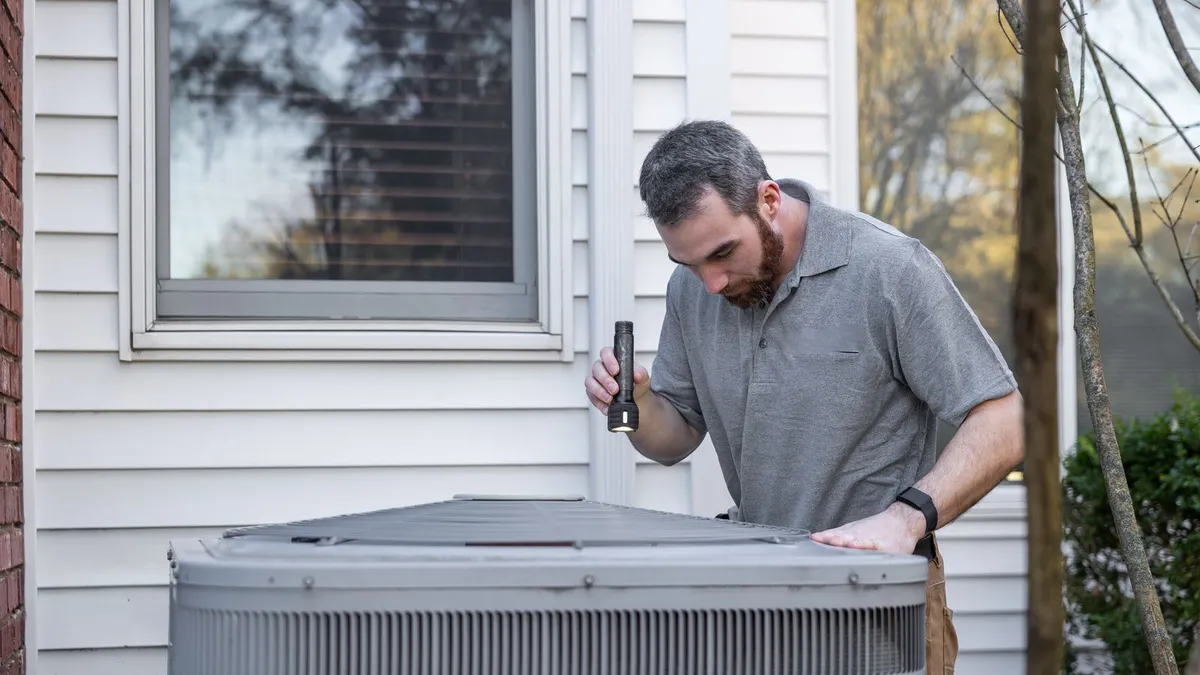
A heat pump that puffs water vapour, stops its outdoor fan and blows cool air for a few minutes is usually working as designed. In a Kelowna winter the outdoor coil spends a lot of time in the band where frost forms, so the unit must melt that frost before it can keep heating. The real question is not whether there is frost, but whether the cycle finishes, clears the coil and returns to normal. This guide gives you the sequence and the signs that justify a service call.
Why does a heat pump frost up when it is just below freezing?
An air-source heat pump pulls heat out of outdoor air. In heating mode the outdoor coil runs colder than the air around it, so moisture condenses and freezes on it. Natural Resources Canada says that near or below freezing, moisture passing over the coil will freeze, and the amount depends on temperature and humidity.
Kelowna spends much of winter in that band. Environment and Climate Change Canada's 1981–2010 normals for the Kelowna airport station put the January daily average at −2.5 °C and the average daily minimum at −5.8 °C. In a typical January, 27.8 days have a minimum at or below 0 °C, 21.5 drop below −2 °C and 5.8 drop below −10 °C. The station records 150.2 such days a year.
Frost is therefore not a sign of failure. It is why the unit has a defrost cycle: frost reduces the coil's ability to transfer heat, so the controls schedule a melt before performance drops too far.
What happens, step by step, during a defrost cycle?
NRCan describes the sequence. The reversing valve flips the system into cooling mode, sending hot gas to the outdoor coil. The outdoor fan shuts off so it does not blow cold air across the coil while ice melts. Inside, the heat pump cools the duct air, and supplementary heat keeps the supply air warm. Mitsubishi Electric's service manual for one outdoor unit adds what you see: water on the outdoor heat exchanger evaporates and water vapour may be emitted.
| Stage | What the unit does | What you may notice |
|---|---|---|
| Heating | Outdoor fan runs; coil stays colder than the outdoor air | Steady warm air indoors |
| Defrost starts | Reversing valve switches; outdoor fan stops | Fan noise stops; indoor air may cool briefly |
| Melting | Hot refrigerant gas warms the outdoor coil | Water vapour, dripping meltwater, frost shrinking |
| Defrost ends | System returns to heating mode | Outdoor fan restarts; warm air returns |
| Later | Cycle repeats when frost builds again | Same pattern every 30, 60 or 90 minutes in damp cold, or less often with demand-frost control |
Indoors, the cycle should feel like a pause. Vents may run cool while the system is in cooling mode, and supplementary heat may carry the house. If the installer set the indoor fan to stop during defrost, the unit goes quiet and NRCan notes defrost may take a little longer. A central system may run electric resistance heat or a furnace. Either way, the interruption is short and heating returns.
How often should defrost run, and how long should it last?
There is no single clock that fits every heat pump. NRCan separates two control strategies. Time-temperature defrost starts and ends on a preset interval or a coil sensor, and can be initiated every 30, 60 or 90 minutes depending on climate and design. Demand-frost controls watch airflow, pressure and coil temperature, and start defrost only when frost is there. NRCan says demand-frost is generally more efficient.
Duration is also unit-specific, and short is the norm. A cycle measured in a few minutes is ordinary. Defrost ends when the unit's coil sensor says the frost has cleared, so the length depends on the model, the outdoor temperature and how much frost has built up. Judge the pattern rather than a stopwatch.
A realistic Kelowna pattern: on a damp morning just below freezing, the unit heats until frost builds, switches into defrost, gives off water vapour, drips meltwater and returns to heating. The interval and length will differ with the model, the humidity and how hard the system is working. Judge the pattern, not a stopwatch.
Two settings are worth checking first. BC Hydro recommends Heat mode in winter rather than Auto, and leaving the temperature setting alone. NRCan recommends keeping any setback to no more than 2 °C, because a heat pump responds more slowly than a furnace. Turning the thermostat up during a defrost pause does not speed the cycle; it only creates a bigger recovery job.
What is normal frost, and what is a real ice problem?
The useful test is whether the ice clears and stays clear. Normal frost is thin and fairly even, and it disappears during the cycle. You may see water vapour, hear the outdoor fan stop, and find a wet patch or some refrozen meltwater at the base. That is the system working.
A fault looks different. The coil stays in a solid shell of ice across several cycles. The outdoor fan is jammed or cannot turn. Ice rebuilds shortly after a cycle ends, or persists in mild weather when the coil should not be collecting frost. Those patterns point at the defrost control, a sensor, airflow or the refrigeration circuit, and they are not homeowner fixes.
| What you see | Usually normal | Worth a service call |
|---|---|---|
| Thin, even frost that clears each cycle | Yes | No |
| Water vapour, a fan pause and brief cool indoor air | Yes | No |
| Meltwater or refrozen slush at the base | Yes, clear it by hand | If it blocks the base or fan |
| Solid ice across the coil that stays for hours | No | Yes |
| Fan blades frozen or the outdoor fan not turning | No | Yes |
| Ice back shortly after a defrost cycle ends | No | Yes |
| Ice that persists in mild weather | No | Yes |
What can you safely check before you call?
Start outside, with your hands and no tools. BC Hydro says to check the outdoor unit at the start of every season and clear dirt, debris, snow, ice and dripping water so air can move. Trane's owner's guide says to clean snow away as soon as possible after it accumulates, because blocked airflow makes the compressor work harder.
Then check the indoor filter. NRCan suggests cleaning or changing it every three months. BC Hydro suggests cleaning filters several times a year and replacing them once a year, following the manufacturer's instructions. A dirty filter restricts airflow through the whole system.
Do not chip, hammer or pry the ice, and do not pour hot water over the coil. Mitsubishi's manual warns against using any means to accelerate defrosting other than those the manufacturer recommends, and Trane's guide says an outdoor unit needs professional maintenance and repair. Note the outdoor temperature, how long the ice lasted, whether the fan turned and any error code. That timeline helps a technician more than a photo of a frosted coil.
When does the behaviour justify a service call?
Call for service when the cycle is not completing, when the unit is not heating, or when a safety device is involved. The specific triggers:
- Solid ice on the coil that survives several defrost cycles.
- Ice returning shortly after a completed defrost.
- The outdoor fan not turning while the system calls for heat.
- Auxiliary heat light on continuously above about −1 °C (30 °F), or on at 10 °C (50 °F); Trane's owner's guide uses those thresholds.
- Breaker trips, repeated shutdowns or an error code.
- A base packed with ice you cannot clear safely by hand.
- The house losing heat faster than the backup can replace it.
Routine maintenance is separate from a repair. BC Hydro suggests scheduling maintenance every one to two years, alternating the season from the last visit, while NRCan recommends annual maintenance by a qualified contractor. A pre-winter visit is a reasonable time to confirm the defrost controls, refrigerant charge and drainage are ready for the cold months.
What should you do after a Kelowna snow or ice storm?
Snow is the part of winter a heat pump cannot defrost its way out of. Keep the top and sides of the outdoor unit clear after a dump, and do not let snow slide off a roof or get shovelled onto the unit. Trane's guidance is to clean snow away as soon as possible and keep airflow open.
Clear loose snow by hand. Do not use a shovel blade, ice pick or hammer on the coil or fan grille; the fins bend and puncture easily. If the unit sits on the ground and the base is buried, clear a path for meltwater to drain. If ice around the base cannot be removed safely, that is a service call, not a DIY project. The roof snow load guide covers the roof; do not climb onto a snowy roof to deal with the heat pump.
Where should you start in Kelowna?
Start with the free checks: clear the unit, check the filter, confirm Heat mode and note the pattern. If the ice does not clear or the fan is not turning, book a licensed HVAC contractor. The HVAC trade page lists local contractors, and the guide to choosing an HVAC contractor explains what to ask about defrost controls and cold-weather performance. The seasonal home maintenance checklist puts the pre-winter check in context, and the Kelowna city hub covers other trades. If the house has no heat, see home repair emergencies in Kelowna.
Sources
- Heating and cooling with a heat pump
Natural Resources Canada · Canada; residential air-source heat pump operation, defrost and maintenance
Accessed November 19, 2026
- Canadian Climate Normals 1981–2010, Kelowna A
Environment and Climate Change Canada · Kelowna A station, British Columbia; 1981–2010 climate normals
Accessed November 19, 2026
- Heat pumps: using and maintaining your heat pump
BC Hydro · Published May 28, 2024 · British Columbia; residential heat pump maintenance and operation
Accessed November 19, 2026
- Tips to maintain your heat pump
BC Hydro · British Columbia; seasonal heat pump checks (BCH20-403)
Accessed November 19, 2026
- Service Manual OCH727 REVISED EDITION-A: Air to Water Heat Pump Units
Mitsubishi Electric · Published 2023-12 · Specific Mitsubishi Electric outdoor units; defrost behaviour and service cautions
Accessed November 19, 2026
- Owner's Guide: Outdoor Units, Heat Pumps and Air Conditioners (22-5213-WEB01)
Trane · Trane residential outdoor units; snow and ice clearance, airflow and auxiliary heat light
Accessed November 19, 2026
- Defrosting your Air-to-Air heat pump
Heating, Refrigeration and Air Conditioning Institute of Canada · Canada; demand-frost and time-temperature defrost methods
Accessed November 19, 2026
Common questions
Is it normal for a heat pump to blow cold air during defrost?
How long should a heat pump defrost cycle last?
Should I chip ice off the outdoor unit?
Why does my heat pump give off steam in winter?
Is ice at the bottom of the heat pump normal?

Written by
Jonathan Larose-Sabourin
Founder, Loonglade Web Studio · Kelowna, British Columbia
Jonathan Larose-Sabourin is the founder of Loonglade Web Studio, the Kelowna-based studio that operates this trades registry. He writes about local home-services rules, costs and maintenance for Kelowna homeowners.
Share this story
Related stories
Home Maintenance
Attic Condensation in Kelowna Winters: Causes and Fixes
A cheap two-visit inspection that separates air-leak condensation from roof-leak water, then fixes air sealing, ventilation and insulation in order.
November 21, 2026 · 8 min read
Home Maintenance
Roof Snow Load in Kelowna: What Homeowners Should Know
The code sets a design load. Your roof needs a site-specific answer, and the difference matters on a heavy snow day.
November 16, 2026 · 10 min read
Home Maintenance
Kelowna Spring Freshet: A Homeowner Checklist
Most freshet damage starts with a blocked path or a failed pump, not a river over the bank. Work through the list before the snowpack goes.
November 16, 2026 · 10 min read
Find hvac in Kelowna
Compare local listings on the HVAC in Kelowna page.
Before you call, read the How to Choose an HVAC Contractor in Kelowna.
Save the pros you trust.
Create a free account to save listings, compare them later, and rate the tradespeople you hire — it helps your neighbours hire well.