
BC Home Energy Rebates for Kelowna Homeowners
Last updated: 2026-10-01
Energy rebates can cover a meaningful part of a heat pump, insulation, window or solar upgrade — but the rules are layered, they change often, and the amount you receive depends on your household, how your home is heated and who does the work. This guide explains how the programs fit together for a Kelowna home, what usually qualifies, and the order of steps that protects your rebate.
How the rebate stack works
Home energy rebates in B.C. come from a few different places, and they do not all stack on the same upgrade. The Province runs two main programs, delivered through your utility — BC Hydro for electrically heated homes and FortisBC for natural gas customers:
- Home Renovation Rebate (HRR) Program — open to households at any income level. It covers heat pumps for electrically heated homes, heat pump water heaters, windows and doors, and insulation. HRR is funded by BC Hydro and FortisBC in partnership with the Province of B.C.
- Energy Savings Program (ESP) — for lower-income households. Rebates are larger and depend on household income, how many people live in the home and the property's assessed value. ESP can cover switching from oil, propane or natural gas heating to an electric heat pump.
- Utility-specific offers — BC Hydro runs separate solar panel and battery storage rebates, and FortisBC lists its own appliance, maintenance and retrofit offers. These sit outside the HRR program.
- Federal programs — the Canada Greener Homes Grant and the Canada Greener Homes Loan are both closed to new applicants. The Canada Greener Homes Affordability Program remains, but it delivers no-cost retrofits to low- and median-income households through BC Hydro and FortisBC, not through direct applications to the federal government.
- Municipal top-ups — some local governments add money to the Home Renovation Rebate Program, and if funds are available they are added automatically when you apply. Check the official program page to see whether Kelowna currently has one.
One rule matters before anything else: HRR rebates cannot be combined with Energy Savings Program funding for the same upgrade, and no combination of rebates can pay more than the cost shown on your invoice. For both provincial programs the home must be a year-round primary residence at least 12 months old, and the utility account must be in your name — accounts held by a strata corporation or landlord do not qualify. Newly built homes, additions and converted spaces are not eligible.
Upgrades that usually qualify
The largest rebates are usually for heat pumps, because they change how your home is heated rather than just how well it is sealed. What qualifies depends on what heats your home now:
- Heat pump replacing electric heat — the HRR rebate was last published at up to $4,000 for a whole-home system and up to $1,500 for partial-home heating. The heat pump must be on the program's eligible product list, and a whole-home system must be sized using a heat load calculation.
- Heat pump replacing oil, propane or natural gas — standard HRR rebates for fossil-fuel conversions are listed for homes north of 100 Mile House, so in Kelowna this path usually runs through the income-based Energy Savings Program, which was last published at up to $13,000 depending on income.
- Heat pump water heater — up to $1,000 through HRR for homes with electric water heating, or up to $3,500 through the Energy Savings Program for income-qualified households.
- Bonuses — two bonus-eligible upgrades installed within 18 months can add a $300 Two Upgrade Bonus, and a pre- and post-upgrade EnerGuide evaluation can earn the Home Energy Improvement Bonus, last published at $20 per percentage point of improvement, with a $750 minimum and $2,000 maximum.
Insulation, windows and solar
These upgrades are often simpler to claim than a heat pump, but each has its own product and installation rules:
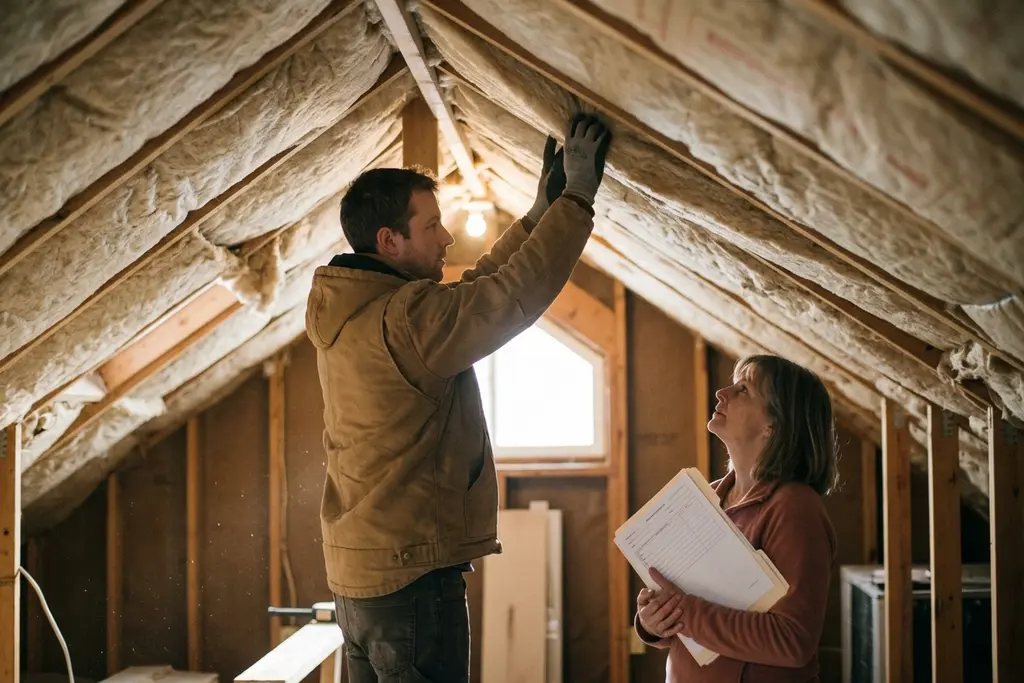
- Insulation — HRR pays by the square foot of insulation added, by location (attic, exterior walls, basement or crawlspace, and other areas), with a published maximum of $5,500 per home. It must be installed by a Home Performance Contractor Network member, the rebate is calculated on the R-value added, and any pest problem in the area being insulated must be resolved before the application is processed.
- Windows and doors — HRR pays $100 per qualifying unit up to $2,000 for Tier 2 windows and doors with a U-factor of 1.22 W/m²·K or less, replacing existing units between heated and unheated space. Skylights are not eligible, and you need a photo of the manufacturer's label for each unit.
- Solar panels and battery storage — not part of the Home Renovation Rebate Program. BC Hydro runs a separate solar and battery rebate program, with different amounts and eligibility, so check the current details on the official BC Hydro page.
Who installs it matters
Rebates are not paid for do-it-yourself work. For the Home Renovation Rebate Program, upgrades must be installed by a licensed contractor with a GST number and a valid B.C. business licence for the trade, and heat pump and insulation rebates specifically require a contractor who is a member of the Home Performance Contractor Network. The Energy Savings Program requires an ESP-registered contractor. Equipment matters too: heat pumps must be on the program's qualified product list, whole-home systems must be sized with a CSA F280-12 heat load calculation, and windows and doors must be certified by a recognized certification body. Ask your contractor for their program registration and confirm it on the official program site before you sign — if they are not registered, the work may not qualify no matter how good it is.
Apply in the right order
The two main programs work in opposite directions, and getting the order wrong is one of the most common ways to lose a rebate. The current requirements also changed for invoices dated on or after May 15, 2026, so read the requirements page for your exact upgrade before you commit:
- Read the current requirements for your upgrade before you sign a contract — they list the product, installation and documentation rules that decide whether you get paid.
- If you qualify for the Energy Savings Program, pre-register in the provincial portal and get your code before any work starts. Your code is valid for three months and can be reused for multiple upgrades; the rebate is paid to your registered contractor and you pay the difference.
- If you are using the Home Renovation Rebate Program, complete the upgrade with a program-registered contractor first, then submit the application and documents within six months of the invoice date.
- Keep everything the application needs: a paid invoice showing a $0 balance, product labels or model numbers, the heat load calculation for a whole-home heat pump, and proof of removal for any fossil-fuel equipment that is being replaced.
- Claim each rebate once — rebates cannot exceed what you actually paid, cannot be claimed twice, and HRR funding cannot be combined with Energy Savings Program funding for the same upgrade.
Red flags worth pausing for
- A contractor who promises a specific rebate amount without checking your home's heating type, your household income and the current program rules.
- A quote that says "we will handle the grant" but names no program, shows no rebate amount and sets out no written terms about who receives the money.
- A price that looks inflated by roughly the rebate amount, or a rebate that disappears into the quote instead of being itemised separately.
- Work started before the program's required step — for the Energy Savings Program that means before you have your pre-registration code, and for any upgrade before you have read and met the current requirements.
- No paid invoice or receipt trail, or a request to pay cash, which can leave you with no documentation when it is time to apply.
Where to start in Kelowna
Start by confirming which program fits your home on the official Better Homes program page and with your utility, BC Hydro or FortisBC, before you talk to contractors. Then browse the local heating and cooling, insulation, window and solar businesses on this directory, and ask each one whether they are registered with the relevant program — the Home Performance Contractor Network for heat pumps and insulation, or the Energy Savings Program's contractor list. Compare quotes with the rebate kept separate from the price so you can see what you are actually paying, and confirm the current rules on the official page before you sign.
Trades mentioned in this guide
Common questions
Do I have to apply before the work starts?
Can I combine the income-based rebate with the Home Renovation Rebate?
Sources
More guides
— For homeowners —
Save the pros you trust.
Create a free account to save listings, compare them later, and rate the tradespeople you hire — it helps your neighbours hire well.